@ini_set( 'upload_max_size' , '300M' ); @ini_set( 'post_max_size', '300M'); @ini_set( 'max_execution_time', '300' );
0

The Nuclear Super Story

The Nuclear Super Story

My point isn’t hinged on the financial cost of managing nuclear waste and accidents only, and even that, Ghana cannot deal with the financial repercussions of a nuclear meltdown and the compounding bills of keeping atomic waste will dig a massive hole in our economy.

They say they come with the bible in one hand and a chain in the other, but often when they preach nuclear power, they don’t talk about the waste and the costly accidents. 

The chatter is that Africa needs cheap electricity to power industries, drive economic growth, ensure prosperity, and improve living standards. A concept that has been tuned across several sectors to bait greedy African leaders to grill, but that is a topic for another day. 

Today, let us stick to the nuclear thing. I read that my government is undertaking public sensitization programs to educate the public on nuclear power. I follow the news, so I know that was just another paid article from a luncheon. Even the so-called sensitization would have been propaganda.

I rarely hear nuclear power enthusiasts talk about the cost of storing nuclear waste. They mostly tout the zero emissions and the low price of producing power. It is estimated to cost the U.S about $50 billion to deal with nuclear waste. Juxtapose that with the $67 billion GDP of Ghana as of 2019. And note, nuclear currently makes up only 20% of the United States’ power mix since the first commercial nuclear power plant opened in 1958. 

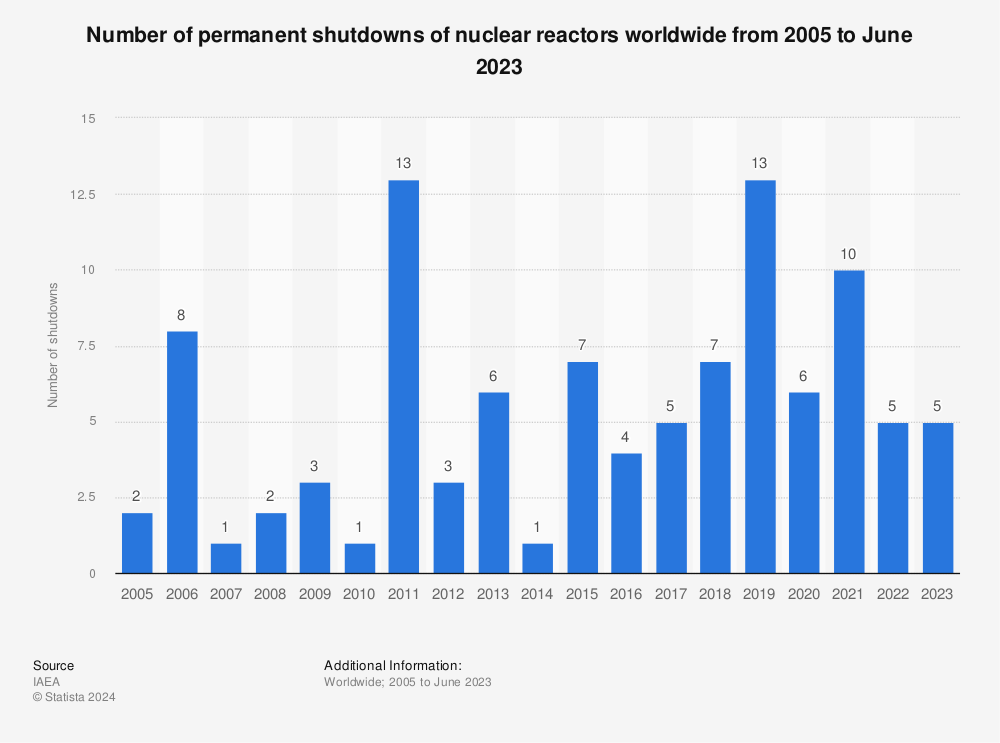
Statistic: Number of permanent nuclear reactor shutdowns worldwide from 2005 to 2021 | Statista
Find more statistics at Statista

Before you pull out the apples and oranges argument, my point isn’t hinged on the financial cost of managing nuclear waste and accidents only, and even that, Ghana cannot deal with the economic repercussions of a nuclear meltdown, and the compounding bills of keeping atomic waste will dig a massive hole in our economy. 

With global affairs, I often get the impression our leaders act like kids in a candy shop. They spend a lot of money traveling and acquiring degrees, but it seems the only essence of those endeavors is a stamp on a passport and a certificate on the wall. 

The world is waking up to the grim realities of nuclear power and countries shutting down their plants. 

In reality, the economy and industries are not owned by Ghanaians. Most of the profits from manufacturing and other industrial activities are flown out of the country, making the economic growth theory another economic imperialist super story.  

Ghana presently has more power production capacity than it requires. Our power issues are currently not about production but mismanagement and corruption. Yes, we will need a cleaner, cheaper energy source, but in the meantime, let us clean house and optimize the units in our current mix. We do not always have to be a dumping ground for archaic ideas.

Before we gamble on nuclear, let us first strive to develop solar capacity as a tropical nation, before joining the cold world. We have the potential to get all domestic consumption onto solar. Let us pursue that and be the leaders of the tropical power: a far more advanced and cleaner form of harvesting nuclear power.

Asak233.com currently does not run adverts, and your contribution, no matter the amount, will go a long way toward sustaining the website and ensuring we continue to deliver on our work.

Share:

Facebook
Twitter
Pinterest
LinkedIn

Leave a comment

On Key

Related Posts

Galamsey: A Crisis of Leadership

Why would a leader of this nation lack the will to stop what clearly has become an existential threat? Well, the simple answer is greed. They can construct impeccable English and cite several excuses as the hindrance, but the real Teflon is greed.
Lewis Hamilton In Red

The car you drive in Formula One makes a great difference, even though this fact usually has different interpretations depending on the subject.